Rostam in the Modern Era: The Heroic Persona & The Decline of Meaning in Today's World
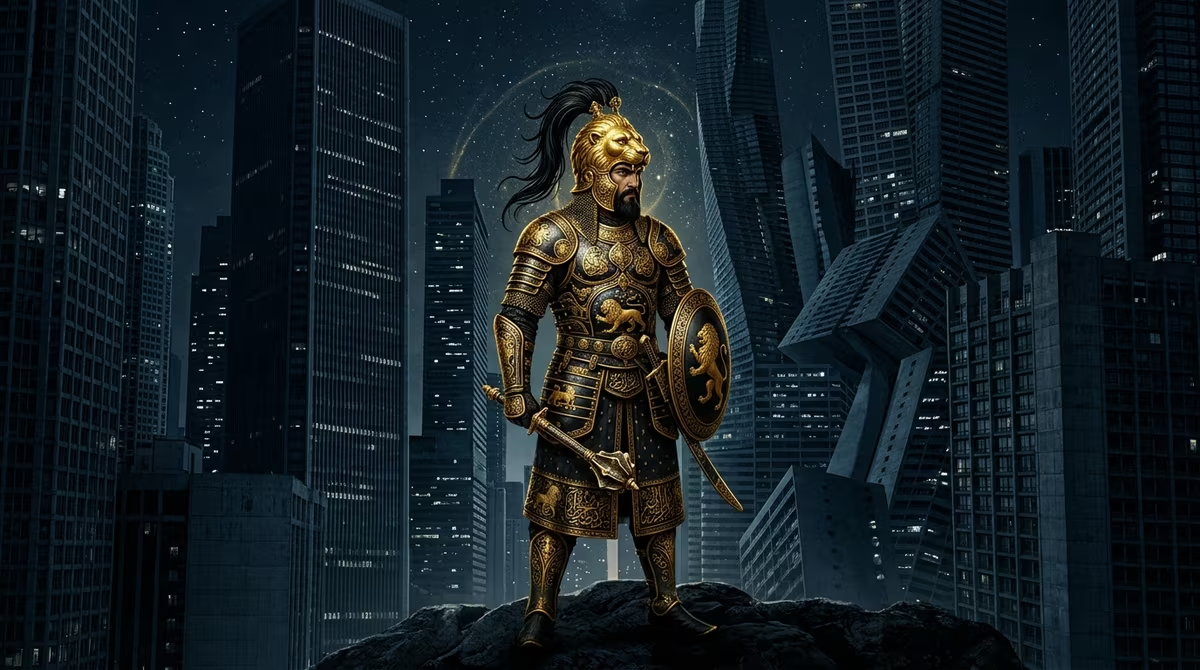
✨ Inscription Summary (Depth Psychological Key)
The legendary champion Rostam faces the erosion of myth and a rigidified Heroic Persona in the modern world. His famous Babr-e Bayan armor, once a protector, becomes an emotional prison preventing the expression of vulnerability and shadow integration, leading to existential crisis.
Rostam in the Modern Era: The Heroic Persona & The Decline of Meaning in Today's World
For millennia, Rostam of Zabol, the peerless champion of the Shahnameh, has been a symbol of power, sacrifice, and national resilience. Yet, through the lens of Carl Gustav Jung's analytical psychology, we realize that Rostam is far more than a warrior; he is the embodiment of the "Hero" archetype and the external manifestation of "The Persona". His armor, the Babr-e Bayan, and his helmet are the social masks that an individual wears to adapt to the external world and meet societal expectations.
In today's modern world, each of us carries a part of this "Rostam" within. But what happens when modern humans, under the heavy weight of Rostam's armor and the heroic mask, completely forget their true identity?
Rostam's Armor: The Archetype of the Persona
In depth psychology, the Persona is the face we present to the world. It is essential for social survival, but danger begins when we fully identify ourselves with this mask (Ego-Persona Identification).
- The Leopard-skin Coat (Babr-e Bayan) & Helmet: Rostam never appears in public without his famous armor and the helmet made from the skull of the White Demon. This attire is a defensive and symbolic Persona that makes him look invincible.
- In Modern Life: Today's humans also wear modern armor; job titles, social status, financial success, and the mask of "always being strong." We have learned never to show weakness, grief, or exhaustion.
Complete identification with the heroic Persona blinds us to our vulnerabilities and causes "psychological colorblindness." We saw this in the tragedy of Sohrab, where Rostam's immersion in his role as the peerless defender of borders led to ignoring his heart and the tragedy of son-killing.
The Crisis of the Weary Hero in a Mythless World
Modern humans are caught in a great paradox: on one hand, they are expected to navigate the seven labors (Haft Khan) of daily, career, and family life, while on the other hand, today's world is devoid of myths, guides, and psychological anchors.
When the hero lacks an inner guide like the Wise Old Man (Zal or Simurgh), their journey of individuation remains incomplete. In today's world, Rostam no longer finds physical demons to fight; his demons have migrated inward: anxiety, meaninglessness, depression, and self-alienation.
Rostam's Shadow: The Price We Pay for Heroism
Every bright Persona hides a dark Shadow behind it. Rostam's Shadow consists of all the weaknesses, fears, and gentle feminine aspects (Anima) that he had to suppress to maintain his heroic majesty.
- Denial of Vulnerability: Rostam is never allowed to cry or shout his exhaustion. He must always be the savior.
- Sudden Eruptions of the Shadow: When the champion suppresses his feelings, his Shadow manifests as destructive rage, uncontrollable pride, or ignoring clear signs.
Returning to the Self: How to Lay Down the Armor
Jung believed that healing and individuation lie in reconciling opposites. The salvation of the modern Rostam does not lie in fighting more battles, but in temporarily removing the mask and armor, and listening to the vulnerable and emotional parts of the psyche.
- Integrating the Anima (The Inner Feminine): Embracing emotions, empathy, and art instead of insisting solely on rigid masculine power.
- Integrating the Shadow: Admitting that we are not always heroic or perfect, and that experiencing failure is a natural part of being human.
Only by laying down this heavy armor can we prevent the repetition of familial and social tragedies and attain true inner peace.
Frequently Asked Questions (FAQ)
❓ What challenge does Rostam's Heroic Persona mirror in modern life?
Like Rostam, modern individuals are forced to appear constantly strong, competent, and invulnerable; this rigid mask blocks the authentic expression of grief, weakness, and inner healing.
❓ What is the psychological symbolism of Rostam's 'Babr-e Bayan' armor?
The armor represents defensive psychological armoring that shields the self, but if never removed, traps the individual in profound emotional isolation.
❓ Why does the modern Rostam experience depression and loss of meaning?
Due to tireless service to external expectations (the ungrateful kings) while ignoring the true Self, leaving the inner hero hollow and exhausted amidst outer accolades.
❓ What is the lesson of Rostam's death in Shaghad's pit of swords?
The trap laid by his brother Shaghad represents betrayal from within and hits from family shadow dynamics, showing that our greatest dangers originate from the blind spots of the psyche.