Zoroaster: The Wise Old Man Who Opened the Path with Questions, Not Swords
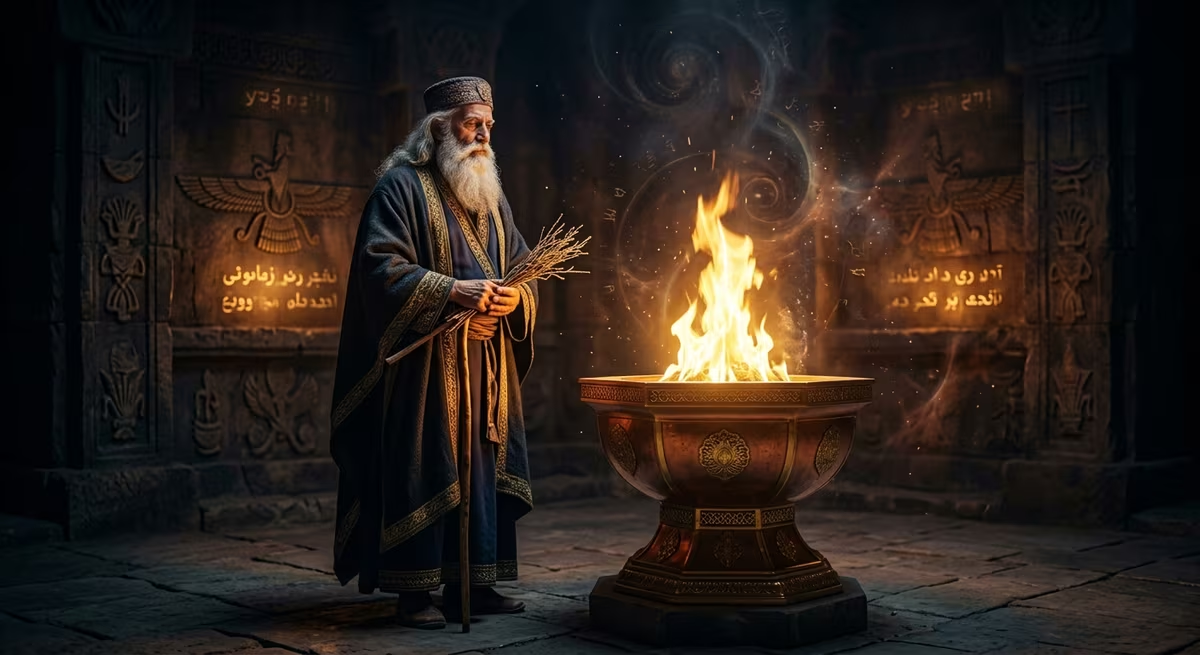
✨ Inscription Summary (Depth Psychological Key)
Zoroaster embodies the Wise Old Man archetype in Iranian myth, whose wisdom stems not from physical power or passive tradition, but from courageous inquiry and independent thinking. He represents the psychic force that emerges from the unconscious to illuminate the path of individuation.
Zoroaster: The Wise Old Man Who Opened the Path with Questions, Not Swords
Among the archetypes of the Wise Old Man in Iranian mythology, Zoroaster holds a position distinct from other symbols of this archetype (such as Jamshid's Cup or the Pir-e Moghan). He is not a symbolic object, nor a completely legendary figure, but a prophet who, as the narrative goes, reached insight through inquiry in his search for truth—rather than through blind obedience or the pursuit of power—forming the foundation of one of the world's oldest religious traditions.
The Wise Old Man Through Jung's Lens
Carl Jung saw the archetype of the Wise Old Man as a symbol of the wisdom that emerges from the depths of the unconscious when consciousness reaches a dead end—not to solve the problem for the individual, but to illuminate the path through insight, questioning, or indirect guidance. This archetype is typically characterized by patience, detachment from worldly clamor, and access to a source of knowledge beyond everyday experience.
Zoroaster: Questioning Instead of Conforming
Traditional narratives of Zoroaster describe him as an individual who, from early childhood, questioned the prevailing beliefs of his era (which he saw as false or incomplete). This quality—the willingness to question accepted assumptions rather than blindly accepting them—is precisely what Jung identified as the prerequisite for attaining true wisdom. It is not the accumulation of information, but the capacity to challenge what "everyone knows to be true."
From a psychological perspective, this questioning is the symbolic equivalent of embarking on an individuation journey: Zoroaster discards external, inherited collective beliefs to reach a more internal and personal truth.
The Duality of Ahura Mazda and Ahriman: A Symbol of Conscious Moral Discrimination
One of the vital heritages of Zoroastrian thought is the clear distinction between the force of good (Ahura Mazda) and the force of evil (Ahriman)—not as two equal, eternal entities, but with the conviction that humans, through the conscious choice of "good thoughts, good words, good deeds," play an active role in this cosmic struggle.
From a Jungian standpoint, this teaching mirrors a deep psychological truth: confronting the shadow (the dark forces within and without) cannot be passive. Zoroaster, as the Wise Old Man, offers not just knowledge about this duality, but a call to conscious moral action—a crucial difference from Wise Old Man archetypes that merely present passive knowledge.
Zoroaster vs. Cyrus: Two Types of Wisdom
Comparing Zoroaster with Cyrus the Great (whom we explored in another article as the symbol of the Wise Ruler) reveals an interesting distinction: Cyrus demonstrates wisdom in political action and the management of external power, whereas Zoroaster manifests wisdom in spiritual inquiry and the redefinition of inner morality. Both are examples of the Wise Old Man, but one operates through external order (just governance) while the other operates through the reconstruction of internal meaning (religious-ethical thought).
Why Zoroaster Matters Today
Zoroaster reminds us that true wisdom often comes not from accepting what we are told, but from the audacity to ask difficult questions about the standard assumptions of our time. In today's world, where information is abundant but deep questioning is rare, this archetype is an eternal invitation: instead of accumulating ready-made beliefs, let us have the courage to rethink what is considered "obvious."
Conclusion
Zoroaster, as one of the most profound manifestations of the Wise Old Man archetype in Iranian culture, demonstrates that the path to wisdom does not always lead through power or tradition; sometimes, it begins precisely by asking the question that no one else had the courage to ask. This heritage, thousands of years after him, remains a living invitation to independent thought and conscious moral choice.
Frequently Asked Questions (FAQ)
❓ Why is Zoroaster considered a dynamic manifestation of the Wise Old Man?
Because unlike elders who preserve passive tradition, Zoroaster forged his path through deep questioning, challenging the dogmas of his era and promoting conscious ethical engagement.
❓ What is the difference between Zoroaster's and Cyrus the Great's wisdom?
Cyrus the Great is the wise ruler embodying external political and administrative integration, whereas Zoroaster is the spiritual guide representing inner spiritual transformation and rebuilding existential meaning.