Sohrab: Puer Aeternus, or the Child Who Never Had the Chance to Mature
✨ Inscription Summary (Depth Psychological Key)
Sohrab is the tragic personification of the Puer Aeternus (the Eternal Boy) archetype in the Shahnameh. Possessing immense potential and courage, his entire existence is tethered to the search for his father Rustam's validation, leading to a tragic death before achieving independent maturity.
Sohrab: Puer Aeternus, or the Child Who Never Had the Chance to Mature
The story of Sohrab is typically narrated from the perspective of Rustam and the "father complex"—which we have explored in another article. However, if we re-examine this story through Sohrab's own lens, we encounter one of the most precise literary depictions of another Jungian concept: Puer Aeternus (the Eternal Boy or Youth).
The Puer Aeternus Through Jung's Lens
Carl Jung and his followers (specifically Marie-Louise von Franz) used the term Puer Aeternus to describe an archetype in which an individual—usually a young man—remains in a perpetual state of potential, aspiration, and seeking, without ever "landing" into earthly life, accepting real-world limits, and achieving full maturity. This archetype is often deeply intertwined with the quest for an external identity, especially the validation of a father or an authority figure.
Sohrab, from the beginning to the end of his saga, lives precisely in this state: he is constantly searching for something he has not yet attained—his father.
The Search for Identity: Sohrab and Rustam's Token
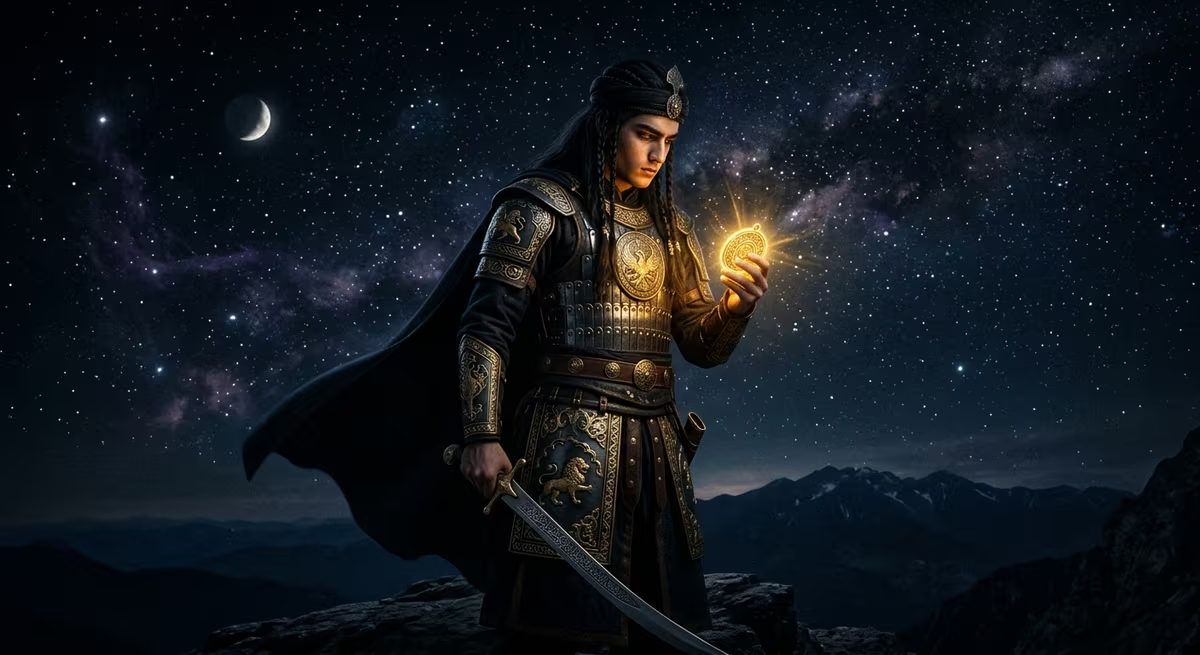
Sohrab, raised by Tahmineh, possesses only a single token of his father—not a real father, nor a lived relationship, but a symbol (the amulet Rustam gave Tahmineh). Sohrab's entire heroic path—invading Iran, confronting champions—is actually a symbolic search to find his father and acquire an identity that is not yet fully formed.
From a Jungian standpoint, this is the classic state of the Puer Aeternus: heroic deeds, immense courage, and outstanding potential exist, yet none of them have "landed" into a concrete, earthly identity. Everything remains suspended, awaiting an external validation or connection (in this case, recognition by the father) that never arrives in time.
The Battle with Rustam: Tragedy of an Unfinished Identity
Sohrab's combat with Rustam, without either knowing whom they are standing against, represents the absolute zenith of this tragedy. Throughout the battle, Sohrab is essentially seeking his father—not as an enemy, but (unconsciously) as the only one who can complete his identity. Sohrab's death at Rustam's hands occurs precisely in the moment he finally uncovers his token and realizes whom he was fighting—the moment his identity is finally completed, but at the exact cost of his life.
From a Jungian perspective, this tragic ending is a powerful symbol of a very real danger within the Puer Aeternus archetype: if an individual remains too long in a state of "waiting to be completed by another," they may never find the opportunity to live an independent, grounded identity before time runs out.
Why Did Sohrab Never Mature?
The key detail is that, unlike many other Shahnameh heroes, Sohrab never experiences a period of independent testing and growth (such as Rustam's Seven Labors) in which his identity could be forged separate from his father. From the very beginning, his entire sense of self is constructed around an absence (the father). This absence, instead of prompting him toward an independent quest for his own identity, traps him in a permanent dependency on finding it.
Lessons of the Puer Aeternus for Today
The Puer Aeternus archetype is a warning for anyone who ties their identity entirely to the approval of an authority figure (parent, mentor, boss), without granting themselves the space to build an independent, grounded self. Sohrab serves as a reminder that raw potential alone does not replace true psychological maturity, and that waiting too long for external validation can carry a devastating price.
Conclusion
When re-examined through his own experiences (rather than merely through the lens of Rustam's tragedy), Sohrab stands as one of the most profound representations of the Puer Aeternus archetype in world literature: a youth of boundless potential whose entire existence was structured around a search for an unfinished identity—to find and be validated by his father—and whose life ends at the very moment that search is resolved.
Frequently Asked Questions (FAQ)
❓ How is the Puer Aeternus complex analyzed in Sohrab's character?
Sohrab remains in a permanent state of potential and yearning. Unlike other champions, he does not undergo independent tests (like the Seven Labors) to forge a distinct identity, conditioning his entire meaning on finding his father.
❓ What is the lesson of Sohrab's myth for modern individuals?
A warning against tethering one's personal identity completely to the validation of authority figures without experiencing independent trials and psychological differentiation; seeking external approval can cost one's true self.