Rudabeh: The Love That Broke the Borders of Two Enemies
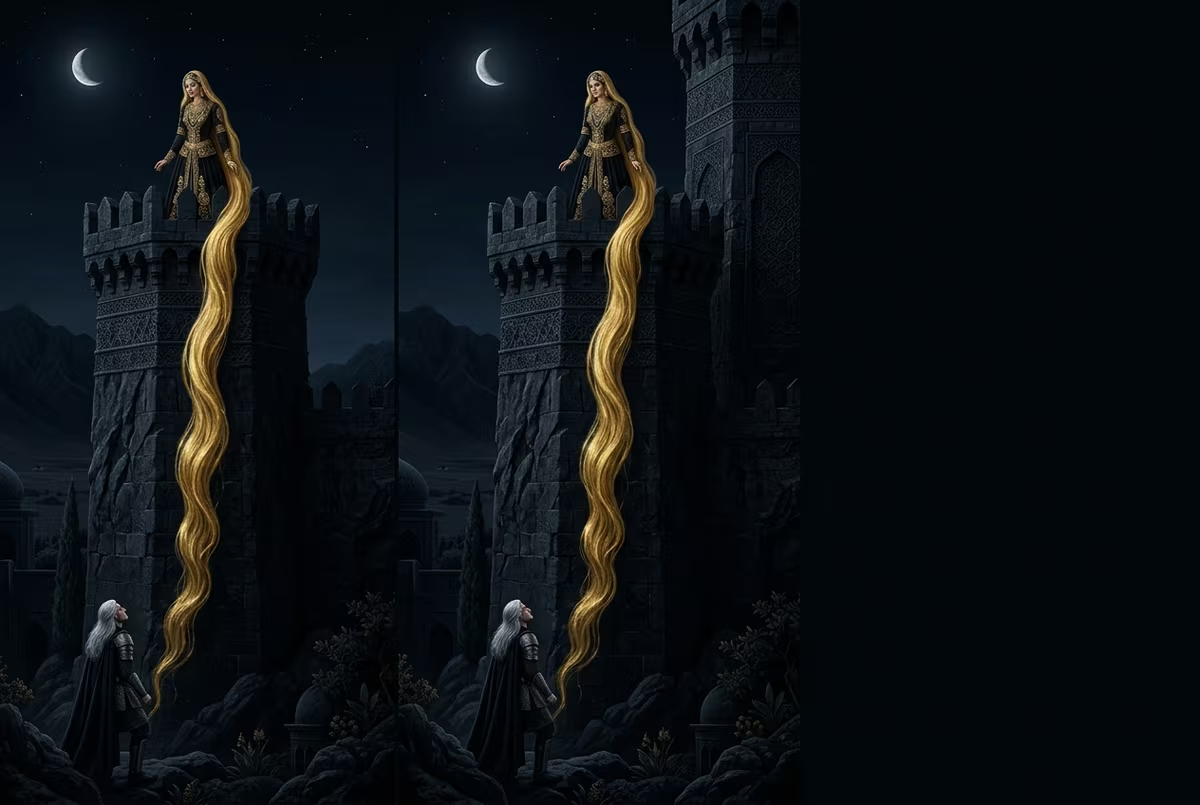
✨ Inscription Summary (Depth Psychological Key)
Rudabeh, the daughter of Mehrab of Kabul, is the manifestation of the active, brave, and independent Anima in the Shahnameh. By courageously crossing political and familial enemy lines and sacrificing her long, shining hair, she built a bridge of love between two rival civilizations.
Rudabeh: The Love That Broke the Borders of Two Enemies
Rudabeh, daughter of Mehrab of Kabul and wife of Zal, is the mother of Rostam, the greatest hero of the Shahnameh. But before becoming Rostam's mother, Rudabeh was herself the protagonist of a love story that challenged the political and familial borders of two hostile lands. This article re-evaluates Rudabeh through the lens of the active and independent Anima archetype—a woman who, like Farangis, stood against family authority, but this time not for justice, but for love.
Love That Began Before the Meeting
Rudabeh's story begins with hearing of the fame of the beauty and bravery of Zal—who had been rejected in infancy due to his white hair and raised by the Simurgh. Rudabeh falls in love with him before even seeing him; a love originating from character and reputation, not merely appearance.
From a Jungian perspective, this can symbolize an Animus (or in this context, an active and independent choice) formed based on the admiration of inner qualities rather than superficial attraction—strictly contrary to the common trope of legendary romances that focus primarily on physical appearance.
The Handmaidens: Rudabeh's First Steps of Independence
To deliver her message to Zal, Rudabeh relies on her handmaidens to design a clever plan—a behavior showing that, contrary to the expectation of her contemporary society for a young woman, from the very beginning of the story, she demonstrates active agency and independent planning.
Rudabeh's Hair: Symbol of Connection and Sacrifice
One of the enduring images of the Shahnameh is the moment Rudabeh sends her long hair down from the tower so Zal can use it to climb. This image, beyond a romantic moment, is a powerful symbol of conscious sacrifice in service of connection—Rudabeh literally makes part of her own existence the instrument to connect two separated worlds.
Two Enemies, One Bond: Beyond Political Borders
Rudabeh and Zal's marriage is met with severe opposition from both sides—Kabul and Zabulistan had tense relations, and Manuchehr, King of Iran, initially opposes this union. However, Rudabeh and Zal, through persistence and the wise mediation of Sam (Zal's father), eventually succeed in forming this bond.
From a Jungian perspective, this story is an allegory of the capacity of conscious love to transcend structural and political contradictions—precisely the role an integrated Anima/Animus can play in joining opposites (not just within the individual, but at the level of social relations).
Rudabeh: Mother of a Hero
Rudabeh's difficult pregnancy with Rostam—which ends with the help of the Simurgh through an advanced delivery (which some consider the first literary reference to a Caesarean section, or "Rostamineh")—shows that even in the creation of the greatest hero of the Shahnameh, Rudabeh played a fully active and central role, not merely a passive biological one.
Why Does Rudabeh Matter Today?
Rudabeh reminds us of the truth that conscious love and insistence on an authentic bond can bridge even the deepest political and familial divides. She shows that independence and sacrifice are not contradictory—one can stand for their own desire while giving of themselves in service of a greater connection.
Conclusion
Rudabeh is often seen less than she deserves, overshadowed by the fame of her son Rostam. But her own story—a love that joined two ancient enemies through intelligence, persistence, and sacrifice—makes her one of the most powerful symbols of the active Anima in the Shahnameh.
Frequently Asked Questions (FAQ)
❓ What is Rudabeh's core archetype in Jungian psychology?
She symbolizes the active and independent Anima. Unlike the traditional image of a passive woman, Rudabeh initiates love, designs the path of connection, and disrupts hostile political borders.
❓ What is the psychological symbolism of Rudabeh lowering her hair from the tower?
Hair symbolizes inner strength, beauty, and personal identity. Offering it to lift her beloved signifies conscious sacrifice and utilizing one's entire being to establish a deep spiritual and emotional connection.
❓ Why is the marriage of Zal and Rudabeh a symbol of the integration of opposites?
Kabul and Zabulistan represented two hostile and opposite worlds. Their union demonstrates the power of conscious love to transcend deep structural barriers and foster peace and integration between incompatible psychic poles.