Layla and Majnun: Anima Projection on the Elusive Beloved
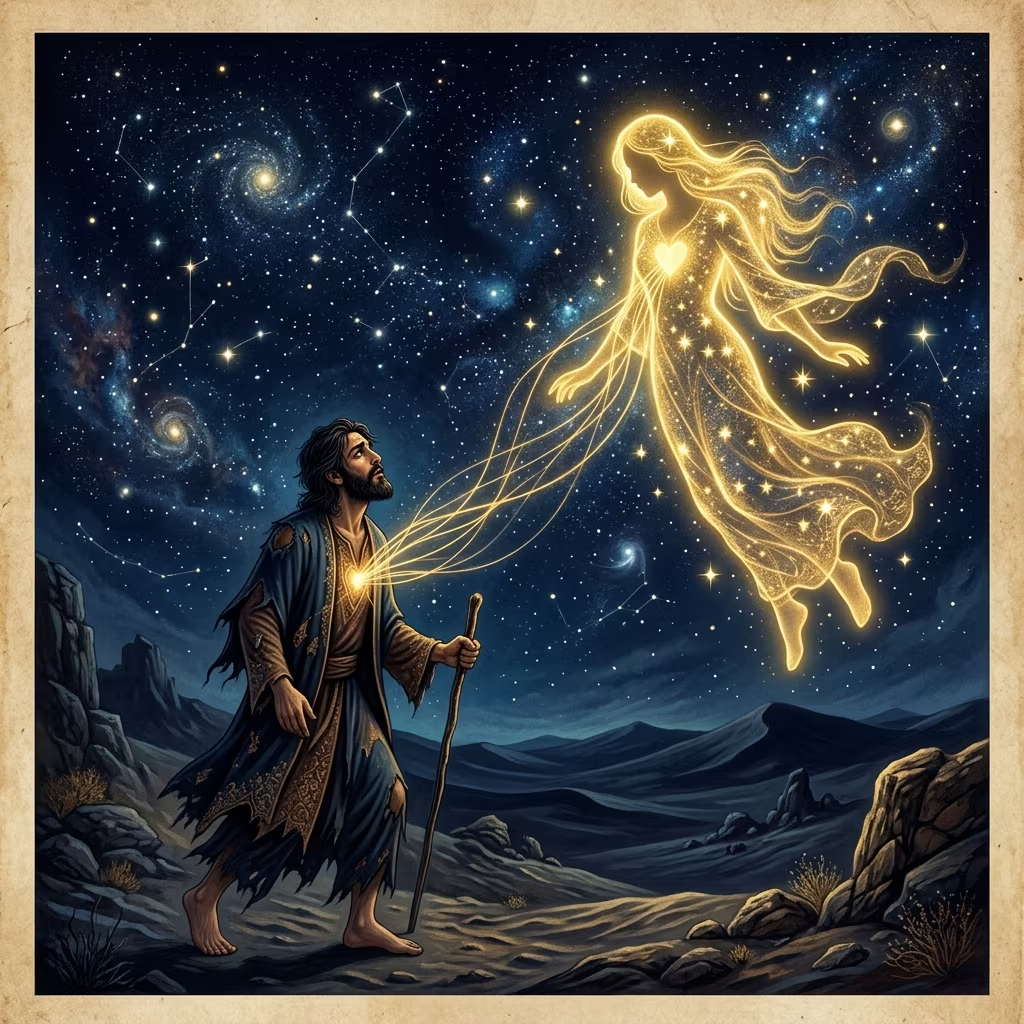
✨ Inscription Summary (Depth Psychological Key)
A psychological analysis of Nizami's masterpiece through the Anima archetype. Majnun's extreme projection of his inner feminine onto the elusive Layla elevates her from a mortal woman to an ethereal deity, leading to the dissolution of the ego and mystical transcendence at the cost of total dissociation from external reality.
Layla and Majnun: Anima Projection on the Elusive Beloved
Nizami Ganjavi's Layla and Majnun is one of the most enduring love stories in world literature—but beyond a simple romance, this epic poem is one of the most precise literary depictions of what Carl Jung called Anima Projection: when a man, instead of recognizing and integrating his inner Anima, projects it entirely onto an external person.
Anima Projection from a Jungian Perspective
Jung explained that the Anima—the feminine aspect of a man's unconscious—is often projected onto an external real person (usually a woman). In this state, that external person is no longer seen as a real human with strengths and weaknesses, but is transformed into an idealized, perfect, and almost divine image—an image that no real human can fully match.
Qays: From Lover to "Majnun"
Qays, the main character, intensifies his love for Layla to such an extent that his personal identity is entirely dissolved in it—so much so that he is no longer called by his real name, but instead is dubbed "Majnun" (the madman). This name change is a powerful symbol: Qays has lost his independent identity and is completely drowned in his projection on Layla.
From a Jungian perspective, this is precisely the danger of extreme Anima projection: instead of being psychologically enriched by integrating his inner Anima, the individual loses his identity completely in dependency on an external object.
The Real Layla vs. The Projected Layla
The tragic and profound aspect of the story is that the real Layla—as a human being with her own desires, limitations, and independent life—almost entirely disappears from the narrative. What Majnun worships is no longer the real Layla, but an idealized and perfected image of her created in his mind. This is exactly the mechanism of Anima projection: the external person becomes a blank canvas for the individual's inner idealized image, rather than being seen as who they actually are.
Why Does Union Never Happen?
A key element of the story is that Layla and Majnun, despite their deep love, never actually achieve union. Symbolically, this can be interpreted as follows: a completely idealized and projected image is fundamentally unattainable—because no real human can perfectly match a mental ideal. The more extreme and idealized the projection, the deeper the gap between the image and reality (and consequently, the failure of the relationship).
The Wilderness: A Symbol of Isolation from Extreme Projection
Majnun eventually retreats into the wilderness, living in complete isolation from society. From a Jungian perspective, this isolation is the logical consequence of extreme projection: an individual who spends all his psychic energy on an unattainable external image gradually distances himself from real, balanced relationships with the outside world.
Conclusion
Nizami's Layla and Majnun, far from being just a romance, offers a delicate and meaningful portrayal of the dangers of extreme Anima projection—where love, instead of enriching one's identity, completely dissolves it into an unattainable external image. This masterpiece, with all its poetic beauty, remains an enduring warning about the importance of recognizing the inner Anima rather than projecting it entirely onto another.
Frequently Asked Questions (FAQ)
❓ Why did Majnun reject Layla's physical presence later in the story?
Because his Anima projection had reached its absolute climax; Layla was no longer a mortal human to him but had become his inner archetype. Physical contact would only compromise his pristine inner image.
❓ What is the difference between Majnun's love and a healthy relationship according to Jung?
A healthy relationship requires withdrawing projections and seeing the partner as they genuinely are; Majnun's love was an absolute projection where the real partner was sacrificed to the lover's idealized inner image.
❓ Why is Majnun's friendship with wild desert beasts psychologically significant?
Wild beasts represent untamed instincts and unconscious forces. By breaking away from human society and his social Persona, Majnun descended into the raw realm of primal instincts and nature.