Gordafarid: The Female Hero's Journey in the Shahnameh
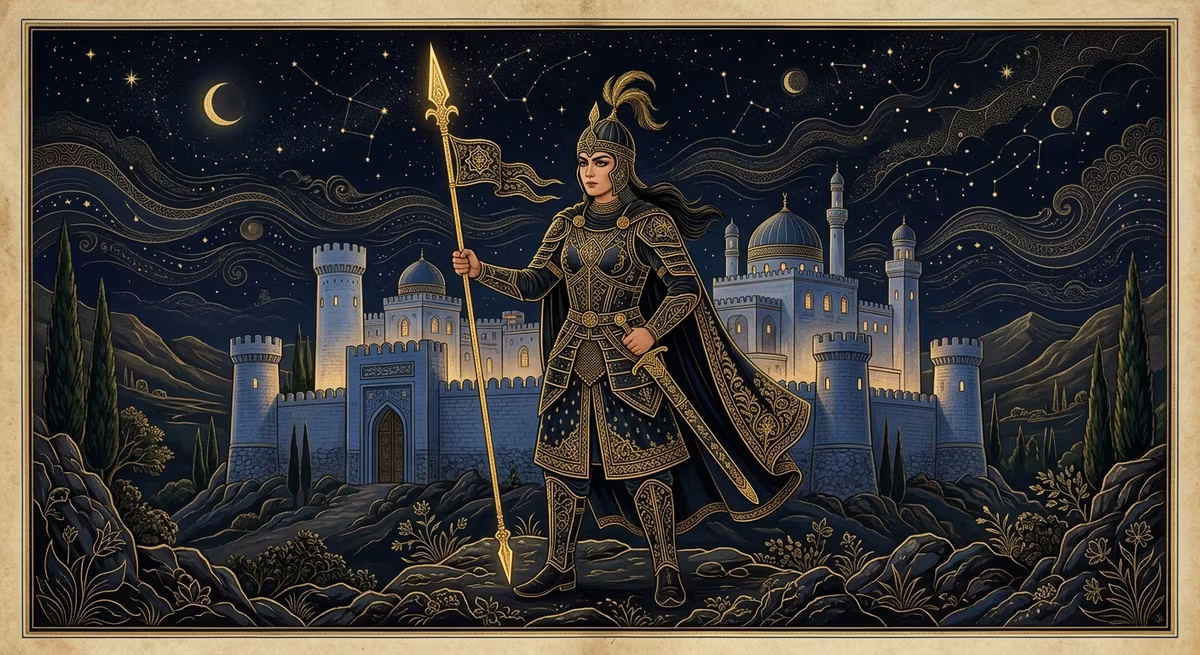
✨ Inscription Summary (Depth Psychological Key)
Gordafarid is a stellar example of integrated Anima and Animus, representing the feminine Hero's Journey. By donning armor and dueling Sohrab, she demonstrates that the Shahnameh's feminine spirit transcends gender boundaries, utilizing both physical bravery and psychological wit.
Gordafarid: The Female Hero's Journey in the Shahnameh
When Joseph Campbell introduced the "Hero's Journey" concept, he outlined a universal pattern for heroic stories: the call to adventure, crossing the threshold, supreme ordeals, and returning transformed. Yet, this template often remains associated almost exclusively with male protagonists. The character of Gordafarid in the Shahnameh stands as one of the clearest Persian illustrations that the hero's journey can be powerfully lived by a woman—and Carl Jung's concept of Individuation provides a precise psychological framework to understand her path.
Who is Gordafarid?
Gordafarid is the daughter of Gazdaham, one of the valiant defenders of White Castle (Dezh-e Sefid), an Iranian fortress on the border of Turan. When Sohrab—the formidable young Turanian champion—attacks the fortress and captures its commander Hajir, Gordafarid, without seeking permission from any man, dons armor, conceals her hair beneath a helmet, and gallops onto the battlefield.
This defining moment—donning armor, confronting Sohrab in single combat, and executing a brilliant strategic withdrawal when the duel turns against her—stands as one of the earliest and most robust depictions of a female warrior in ancient Persian literature.
The Hero's Journey Through Campbell and Jung
Campbell, heavily influenced by Jungian analytical psychology, divided the hero's journey into three main movements:
- Departure — leaving the familiar world.
- Initiation — encountering trials, allies, and enemies.
- Return — integrating the acquired wisdom back into the home world.
In Jungian terms, this external quest is a metaphor for the internal journey of individuation: the psychic evolution from the Ego toward the integration of the complete, unified Self. Every external ordeal is actually a confrontation with an unintegrated aspect of the hero's own unconscious.
Stage 1: Departure — Transcending Gender Boundaries
Gordafarid’s departure is not just about exiting a physical gate; it is a departure from a prescribed social role. In a culture where combat is deemed an exclusively male duty, her autonomous decision to put on armor is her threshold crossing—the "Call to Adventure" and refusal to remain passive.
This act also represents an highly active, integrated Animus (the inner masculine archetype in a woman): initiative, strategic clarity, and decisive action without reliance on external paternal validation.
Stage 2: Initiation — The Encounter with Sohrab
The duel between Gordafarid and Sohrab is more than a military encounter. Symbolically, Sohrab represents an untamed, youthful, and conquering force—an embodiment of raw, unchanneled instinctual energy. By fighting him, Gordafarid confronts an external "Shadow" of immense power.
The genius of the narrative lies in the outcome: she is not physically crushed, but uses wit rather than matching raw force to survive. She raises her helmet, using her beauty and intellect to stun Sohrab, and retreats into the safety of the fortress. This action demonstrates a hallmark of a highly individated psyche: a true hero knows that brute force is not the only path to survival, and that strategic withdrawal is sometimes the ultimate expression of wisdom.
Stage 3: Return — The Synthesis of Dual Forces
Upon returning, Gordafarid does not retreat in defeat. Rather, she returns as a woman who has proven mastery over both fields: the martial domain (the masculine force) and strategic cunning/grace (the feminine force). This is the archetype of what Jung calls the conjunction of opposites (Mysterium Coniunctionis)—the integration of Animus and Anima, where neither suppresses the other.
Rather than becoming a mere copy of a male soldier, or rejecting her physical strength entirely, she integrates both into a singular, cohesive identity. This represents the ultimate balance of a healthy, individated psyche.
Why Gordafarid Matters Today
Gordafarid's story, far from being just an ancient legend, serves as a timeless archetype for anyone—especially women—confronting expectations of passivity, choosing instead to enter the arena of life on their own terms. Her journey reminds us that individuation is not about deleting parts of ourselves to fit a mold, but about synthesizing all of our inner elements—masculine and feminine alike—in service of a higher consciousness.
Conclusion
Gordafarid demonstrates that the hero’s journey, as defined by Campbell and Jung, knows no gender boundaries. Her departure from a passive role, her initiation on the battlefield, and her return with integrated strength and wit remain one of the most complete illustrations of individuation in epic mythology—written thousands of years before the terminology of modern psychology was ever established.
Frequently Asked Questions (FAQ)
❓ How does Gordafarid demonstrate the integration of Anima and Animus?
She masterfully coordinates both assertive combat prowess (masculine Animus) and refined wit, verbal grace, and strategic deception (feminine Anima) to outsmart her opponent.
❓ What is symbolized by Gordafarid's falling helmet?
The falling helmet symbolizes the removal of the warrior Persona, exposing her true self and genuine feminine nature (Anima) in the midst of battle.
❓ How does Gordafarid's Hero's Journey differ from Rostam's?
While Rostam's journey is heavily centered on physical strength and direct combat, Gordafarid's journey is a creative fusion of physical courage and deep psychological diplomacy.
❓ Why did Gordafarid refuse to let Sohrab into the castle?
The castle represents the secure boundaries of the psyche. Gordafarid realized that admitting an invading force would lead to the collapse of identity, thus protecting her psychological margins.