Fereydun: The Hero Who Integrated the Shadow, Rather Than Simply Destroying It
✨ Inscription Summary (Depth Psychological Key)
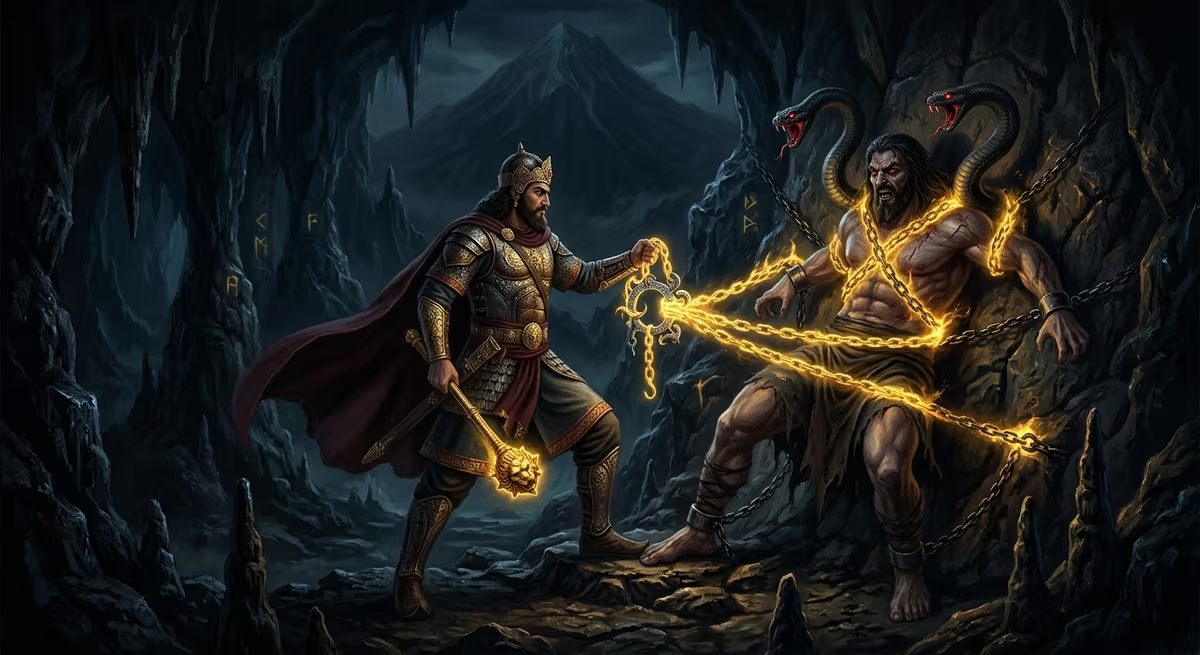
Fereydun represents the hero who completes the process of shadow integration. After defeating Zahhak (the repressed personal shadow), he does not execute him but shackles him inside Mount Damavand. This symbolic containment mirrors Jung's concept of integrating the shadow rather than denying it.
Fereydun: The Hero Who Integrated the Shadow, Rather Than Simply Destroying It
In the trilogy of Zahhak, Kaveh, and Fereydun, the Shahnameh delivers one of literature's most comprehensive psychological narratives on confronting the shadow across three distinct levels: Zahhak representing the repressed personal shadow, Kaveh symbolizing the release of the collective shadow, and Fereydun embodying the psychological force that integrates and channels this unleashed shadow rather than suppressing it once more.
Why Defeating Zahhak Alone Is Not Enough
From a Jungian standpoint, merely "destroying" the shadow is not the ultimate objective of the individuation process. Jung emphasized that the goal is the integration of the shadow into a larger, more balanced whole, rather than its denial or complete annihilation. This is because the shadow, despite its darkness, carries vital and creative psychic energy that cannot simply be severed from the psyche.
After defeating Zahhak, Fereydun does not execute him; instead, he shackles and imprisons him inside Mount Damavand. This symbolic choice is crucial: Zahhak is not destroyed, but rather restrained and managed. From a Jungian perspective, this perfectly mirrors the truth that the shadow never fully disappears; instead, it must be recognized, bound, and kept in its proper place so it does not resume control over one's life.
Fereydun as the Symbol of Integration
Unlike Kaveh, who represents raw, liberated collective suffering, Fereydun represents a balanced and responsible agency—one who possesses both the courage to confront tyranny and the wisdom to manage the consequences of that confrontation. He takes the raw energy unleashed by Kaveh’s uprising and channels it into a new order, preventing it from collapsing into aimless chaos.
This is precisely the role played by the Self in Jungian individuation: it is neither a tyrant that represses the shadow nor a victim that surrenders to it. Instead, the Self is the organizing center capable of harmonizing all opposing elements of the psyche, including the shadow, into a cohesive whole.
Dividing the Kingdom: Embracing Complexity
A lesser-known part of Fereydun's story is that towards the end of his reign, he divides his empire among his three sons (Salm, Tur, and Iraj)—a decision that ultimately triggers subsequent tragedies in the Shahnameh, including the bloody conflicts between Iran and Turan. This moral complexity is vital: Fereydun, despite being an integrative hero, is not flawless. He, too, makes decisions that carry complex and painful consequences.
From a Jungian perspective, this serves as a reminder of a profound truth: even an individual who has achieved a high level of psychological integration is still a mortal human with limitations and imperfect decisions. Individuation does not mean absolute perfection; it means awareness and accountability in the face of life's complexities.
Three Levels of the Shadow: From Zahhak to Kaveh to Fereydun
When we view these three archetypal figures together, a complete psychological pattern emerges:
-
Zahhak demonstrates how a repressed personal shadow, if constantly fed, metastasizes into widespread tyranny.
-
Kaveh demonstrates how accumulated collective grief can be released and converted into conscious action through a simple, unifying symbol.
-
Fereydun demonstrates how this newly liberated energy, instead of degrading into chaos, can be steered toward a more balanced, mature order—while accepting that even this new order will have its own flaws and limitations.
Why Fereydun Matters Today
Fereydun reminds us that confronting injustice or encountering the shadow—whether personally or socially—is only half the journey. The other half is the ability to responsibly guide that unleashed energy toward a constructive architecture, without expecting that this new structure will be completely flawless.
Conclusion
Fereydun, serving as the culminating figure of the Zahhak-Kaveh-Fereydun trilogy, offers a perfect blueprint for shadow integration: neither denial nor re-repression, but rather wise containment and the deliberate channeling of raw psychic energy into a higher order—an order which, like any human structure, will carry its own unique complexities and boundaries.
Frequently Asked Questions (FAQ)
❓ Why does shackling Zahhak in Damavand align with shadow integration?
Because executing Zahhak would mean denying the shadow. The shadow holds essential vital energy; its destruction leaves the psyche soulless. Containment in Damavand means consciously managing dark forces without trying to destroy them.
❓ How is Fereydun viewed as a manifestation of the Self?
The Self functions to reconcile opposites and establish harmony. Following the storm of collective rage (Kaveh) and absolute darkness (Zahhak), Fereydun institutes a new, balanced order.