The Father Complex & Tragedy of Son-Killing: Jungian Analysis of Rostam and Sohrab
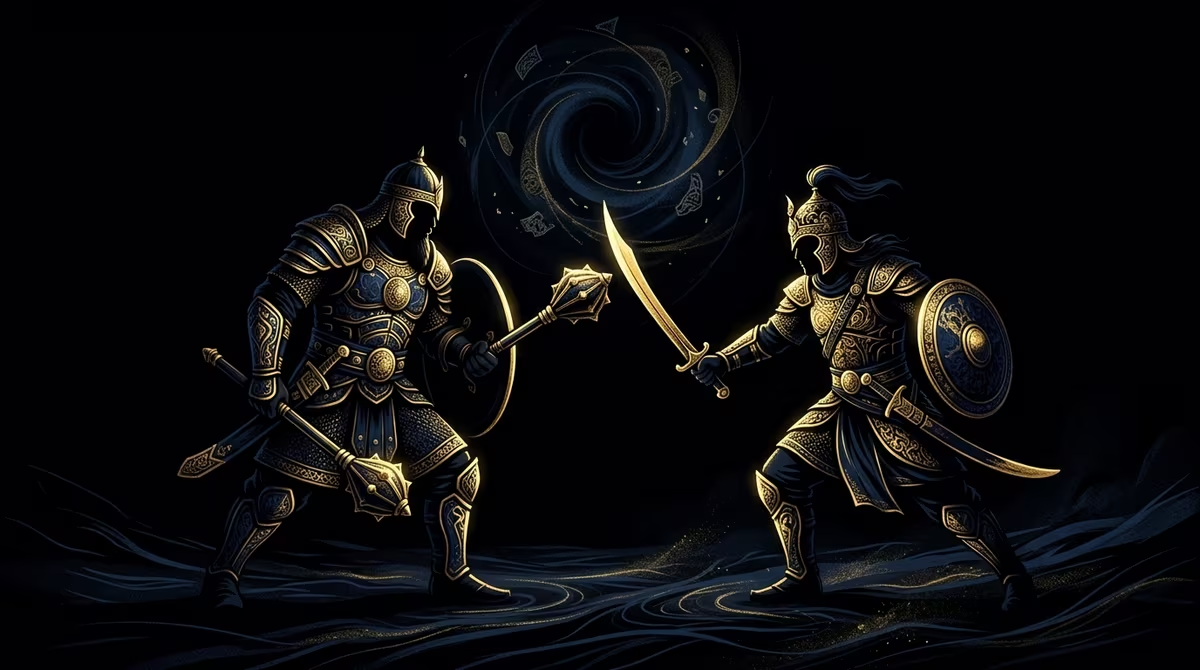
✨ Inscription Summary (Depth Psychological Key)
The fatal combat of Rostam and Sohrab is a bloody manifestation of the Father Complex and generational friction. Rostam, failing to recognize his son and sacrificing him for state structures, represents stagnant consciousness extinguishing the budding force of new awareness.
The Father Complex & Tragedy of Son-Killing: Jungian Analysis of Rostam and Sohrab
The tragedy of Rostam and Sohrab in Ferdowsi's Shahnameh is not merely a story of a heroic battle and a fateful mistake. From the perspective of Carl Gustav Jung's analytical psychology, this epic is one of the deepest manifestations of the collective unconscious and a clear symbol of the psychological manifestation of the "Father Complex" (Father Complex) and the confrontation between different realms of the human psyche.
In this article, we explore the key question of why in Persian mythology, unlike Greek mythology (where son-killing or Oedipus complex is rare and patricide is more common), we encounter the horrific phenomenon of "son-killing" and what this event means for the psyche of modern humans.
What is the Father Complex?
In depth psychology, complexes are collections of repressed thoughts, feelings, and memories in the unconscious that attract intense psychic energy around a specific theme (such as father or mother).
- In its positive aspect: The father is a symbol of law, structure, logic, and consciousness.
- In its negative aspect: The father becomes a symbol of tyranny, suppression of innovation, and fear of losing power.
When this complex remains unresolved in the psyche of a society or individual, the old consciousness (Rostam) perceives the presence of a young and dynamic force (Sohrab) not as an extension of himself, but as a threatening, life-disrupting force and a dangerous shadow.
Why Didn't Rostam Recognize Sohrab? (Psychological Colorblindness)
One of the key questions of the story is: how did the champion of the world, with all his wisdom and intelligence, fail to see the signs and did not recognize his own son?
From a Jungian perspective, Rostam suffered from a "psychological colorblindness" or falling into Ego Inflation. At this point in the story, Rostam is more than just an individual; he is the complete embodiment of the establishment of power and the guardian of the status quo (Kavus's kingdom). He is so immersed in his archetypal role as "the champion defending the borders" that the individual and emotional dimensions of his psyche (symbolized by his son Sohrab) are completely eclipsed.
Sohrab was not a person or a son to Rostam; he was the unconscious embodiment of Rostam's fears of aging, decline of power, and being replaced by a fresh, youthful force. Tahmineh gave the armlet to be a sign, but the power complex had blinded Rostam's eyes.
Sohrab: The Symbol of Emerging Consciousness That Died Prematurely
Sohrab, on the other hand, represents the power of youth, freshness, and the urge for change. He sets out to find his identity (the father). In the structure of the psyche, Sohrab represents new ideas and the budding of changes in the unconscious that want to emerge to the level of consciousness.
However, Sohrab's mistake was that he wanted to achieve this transformation with haste and through military conquest (overthrowing Kavus and Afrasiab). He underestimated the old, deeply rooted structure of the psyche (Rostam).
Frequently Asked Questions (FAQ)
❓ How does the Father Complex manifest in the story of Rostam and Sohrab?
Through Rostam's unconscious fear of being superseded by a younger power, and Sohrab's obsessive yearning to receive confirmation and validation from his father.
❓ Why did Rostam hide his identity from Sohrab?
Concealing his name demonstrates Rostam's attachment to his high-status warrior Persona and his fear of vulnerability; a psychological denial that ultimately slaughtered the truth.
❓ What does 'Noshdaru' (the antidote) represent?
It symbolizes 'Late Consciousness' and regret; the moment the Ego finally wakes up to the truth, but the trauma is done, and restoration is no longer possible.
❓ Why did the tyrannical King Kay Kavus refuse to provide the antidote?
Kavus represents the Neurotic Sovereign who feared the potential union of the old power (Rostam) and new vitality (Sohrab), choosing to let the psyche stay castrated and grieving.