Farangis and Animus: The Archetype of the Masculine Within the Feminine in the Shahnameh
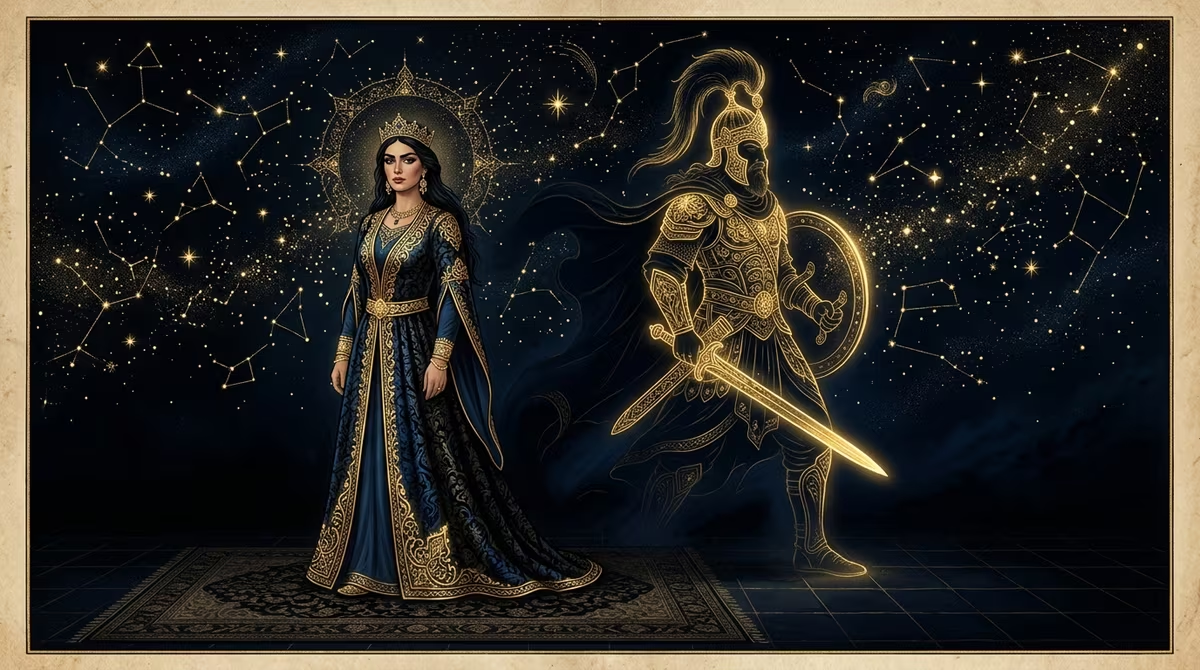
✨ Inscription Summary (Depth Psychological Key)
Farangis, daughter of Afrasiab and wife of Siavash, is a supreme manifestation of the positive Animus (rational wisdom and resilient female will). Rising above the devastating trauma of her husband's murder, she combines maternal instinct with political action to preserve the royal line and her own agency.
Farangis and Animus: The Archetype of the Masculine Within the Feminine in the Shahnameh
Among the hundreds of female characters in the Shahnameh, few embody a complex Jungian psychology concept as completely as Farangis, daughter of Afrasiab and wife of Siavash: Animus, the masculine aspect of the female unconscious. Rather than a minor or passive figure, Farangis is a woman standing between two lands, two loyalties, and two value systems. Guided by intellect, will, and a resolve that Jung defines as core traits of the Animus, she shapes her own destiny and that of her son, Kai Khosrow.
This article attempts to show how the story of Farangis, far from being just an epic narrative, serves as a roadmap to understanding one of the most critical archetypes of the human psyche.
What is Animus According to Jung?
Carl Gustav Jung believed that the psyche of every human, regardless of biological sex, contains both feminine and masculine poles. While Anima refers to the feminine side of a man's unconscious, Animus represents the masculine side of a woman's unconscious.
The Animus usually appears in the female unconscious not as a single figure, but in multiple forms or as an "assembly of men." Jung describes four stages of Animus development:
- Physical Power — symbolized by physical heroism and athletic prowess.
- Initiative and Action — symbolized by a man who plans and takes action.
- Word and Meaning — symbolized by a speaker, teacher, or prophet.
- Spirituality and Wisdom — the highest stage, associated with a spiritual guide.
A healthy and integrated Animus helps a woman achieve assertiveness, intellectual independence, and logical decision-making. Conversely, a repressed or discordant Animus can manifest as blind obstinacy, dogmatic opinions, or extreme dependency on external masculine viewpoints.
Crucially, in post-Jungian psychology and Persian literary criticism, scholars have applied this concept specifically to Shahnameh characters, notably positioning Farangis as an embodiment of the "positive Animus" in contrast to characters like Sudabeh (who represents the negative Animus).
Who is Farangis?
Farangis is the daughter of Afrasiab, King of Turan. She marries Siavash, the Iranian prince who fled Iran due to Sudabeh's malice and took refuge in Turan. This union is the most symbolic marriage in the Shahnameh: the meeting and alliance of two enemy lands, Iran and Turan.
Yet, this peace does not last. Afrasiab, influenced by the suspicion and conspiracy of Garsivaz, orders Siavash's execution—a cruel murder that instantly deprives Farangis of her husband, her homeland, and her security.
From this pivotal moment, Farangis's story transitions from a "supporting role" to one of independent, decisive agency.
Manifestation of the Animus in Farangis's Actions
1. Resistance Against Fatherly Authority
When Afrasiab orders the execution of Siavash, Farangis—contrary to the patriarchal expectations of her era—stands up against her father. This resistance is a clear sign of an active Animus: a woman who, instead of passively accepting the will of the dominant male figure (her father), exercises her own intellect and will to make an independent moral judgment.
From a Jungian perspective, this moment represents the third stage of the Animus—where a woman is no longer merely reactive, but instead declares her own value system against an external one with voice and conscious stance.
2. Protection and Upbringing of Kai Khosrow
Following Siavash's death, Farangis assumes sole responsibility for raising her son, Kai Khosrow—a child destined to return to Iran, avenge his father's blood, and become a just king.
This role is a blend of maternal care (which can be seen as the Anima aspect of the story) and strategic guidance to prepare her child for a great historical mission—a function that, within the Jungian framework, closely aligns with the fourth stage of the Animus (wisdom and spiritual guidance).
3. Loyalty to an Ideal, Not a Territory
Farangis is caught between two identities: daughter of the Turanian Afrasiab, and mother of the future Iranian King Kai Khosrow. Yet, her loyalty is not to a specific land, but to a moral principle—justice against oppression. This choice is one of the clearest manifestations of an integrated Animus: a rationality that operates based on an internal value system, transcending tribal and emotional attachments.
Farangis vs. Sudabeh: Two Sides of the Animus
Scholars of mythological criticism often contrast Farangis and Sudabeh. Sudabeh, Siavash's stepmother, represents the negative Animus: plotting, deception, and emotional manipulation instead of direct, transparent action. To achieve her desires, Sudabeh resorts to conspiracy rather than honest confrontation—a behavior that, in the Jungian framework, indicates an Animus that has been repressed and destructively projected rather than integrated.
In contrast, Farangis acts directly, honestly, and responsibly. This contrast is a psychological lesson in itself: the difference between an Animus placed in service of growth and truth, versus one used for control and deceit.
Why This Archetype Still Matters Today
Understanding the Animus is a valuable tool for self-knowledge, both for women and for understanding the psychic dynamics of those around them. A woman at peace with her Animus can:
- Make independent decisions in critical situations, rather than defaulting to passivity or absolute dependence on others.
- Stand with clarity against unjust authority (whether in family or the workplace).
- Assume grand responsibilities with a combination of rationality and compassion.
The story of Farangis gifted us this psychological pattern in the form of an epic narrative, thousands of years before the word "Animus" was even coined. This is one of the most beautiful examples of why Persian myths remain a treasure trove for understanding the contemporary human psyche.
Conclusion
Clothed in epic narrative, Farangis is a psychological model of a woman who neither repressed her Animus nor let it achieve destructive dominance, but rather harnessed it in service of justice, care, and shaping the future. This synthesis of ancient Persian myth and Jungian analytical psychology demonstrates that the Shahnameh is not only a literary masterpiece, but a psychological encyclopedia that still holds untold insights for our self-discovery today.
Frequently Asked Questions (FAQ)
❓ How does Farangis represent the positive Animus?
Her Animus is channeled not as hostility, but as logical wisdom, iron resolve, resistance against her father's tyranny, and nurturing Kay Khosrow to restore balance.
❓ What does the crossing of the Oxus (Jayhun) river represent?
The wild river symbolizes the dangerous crossing of emotional turbulence and trauma limits, moving toward the territory of higher consciousness (Iran) and rebirth.
❓ What does Farangis's conflict with her father represent?
Confronting the Father Complex, transcending blind loyalty to an abusive authority for the sake of truth, justice, and genuine love.
❓ Why is Farangis pivotal to the restoration of Iran's kingdom?
As a hero-mother, she bridges opposite forces (Turan and Iran bloodlines), and her nurturing presence protects Kay Khosrow, the symbol of the perfect integrated Self.