Esfandiyar: Imprisoned Within the Invulnerable Persona
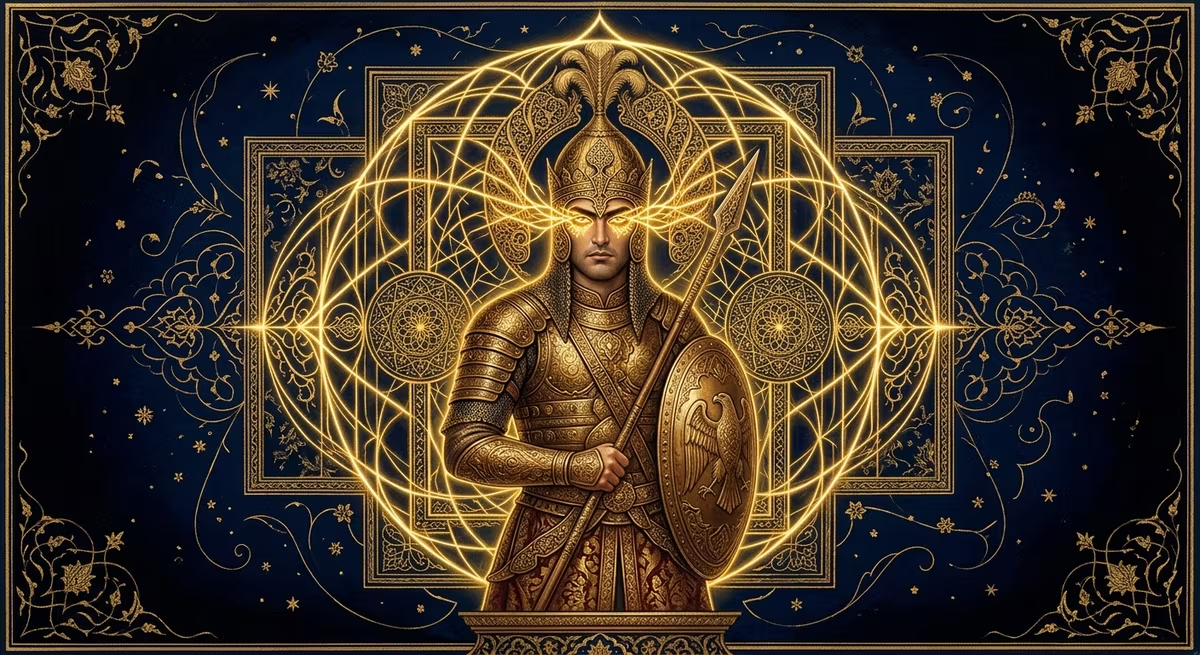
✨ Inscription Summary (Depth Psychological Key)
Esfandiyar is an invulnerable hero whose psyche is trapped within his rigid social mask (Persona). His total identification with the archetype of the dutiful warrior and the promised king separates him from the higher Self, leading to the tragedy of combat and psychological downfall.
Esfandiyar: Imprisoned Within the Invulnerable Persona
Esfandiyar, the invulnerable prince of Iran, is one of the most tragic figures in the Shahnameh. The unfulfilled promise of kingship made by his father, Goshtasp, drags him into a deadly conflict with Rustam—a duel in which Esfandiyar, despite his physical invulnerability (except for his eyes), ultimately loses his life. This article explores Esfandiyar through the lens of the Jungian concept of the Persona: the social mask an individual wears to adapt to societal expectations, and the psychological danger that arises when this mask is mistaken for one's true identity.
The Persona According to Jung
Carl Jung described the persona as a "mask" that an individual designs to present themselves to the external world—a combination of social roles, cultural expectations, and the image we wish others to see. The persona is, in itself, an essential and healthy component of social adaptation. The problem arises when an individual identifies too closely with their persona, equating it with their true identity (the Self), and becomes completely detached from the deeper layers of their psyche.
Throughout his narrative, Esfandiyar is a prince whose identity is entirely fused with the role of "the invulnerable champion, the defender of the faith, and the heir to the throne." This role is so powerful and dazzling that he can no longer conceive of himself outside of it—precisely the psychological danger that Jung warned against.
Invulnerability: A Metaphor for the Impenetrable Mask
Esfandiyar's physical attribute—his invulnerability to any weapon, except for his eyes—is a perfect metaphor for an excessively rigid, thick persona. He appears immune to any external wound, but this absolute immunity deprives him of the vulnerability necessary for psychological growth.
His only vulnerability—his eyes—is symbolically the only opening through which he can perceive a truth beyond his mask. Ironically, it is this exact point (which the Simurgh revealed to Zal) that causes his demise. This serves as a powerful illustration of a Jungian truth: it is only through the small cracks in the otherwise solid mask of the persona that an individual can encounter the deeper truth of their existence—even if that encounter is painful or fatal.
The Unfulfilled Promise of Kingship: Trapped in the Anticipation of the Mask
Goshtasp, Esfandiyar's father, repeatedly promises to hand over the throne, but postpones it each time with a new pretext (such as demanding that Esfandiyar bring Rustam in chains). Instead of defining his identity beyond this promise, Esfandiyar remains entirely trapped in the anticipation of its fulfillment—waiting for the ultimate completion of his persona as "the future king."
From a Jungian perspective, this state of anticipation is one of the most hazardous psychological traps: an individual tying their absolute worth and identity to an external role that is entirely controlled by another (in this case, his father). Esfandiyar cannot imagine himself without that role. Consequently, even when Rustam warns him that this battle serves no one, Esfandiyar refuses to deviate from his path—because turning back would mean abandoning the promised mask.
Duel with Rustam: The Mask Confronts the Unknown Self
In many Jungian analyses of the Shahnameh, Rustam represents an older, more integrated, and more natural force of the psyche—not an imposed social role, but an identity forged from lived experience and inner wholeness. In a symbolic reading, the duel between Esfandiyar and Rustam can be understood as the confrontation between the rigid, external Persona and the integrated, authentic Self.
From this viewpoint, the tragedy of Esfandiyar's death is not merely a military defeat. It is a profound demonstration that when an individual becomes entirely identical with their mask, stripping themselves of flexibility and self-reflection, they appear fragile and ultimately broken when confronted with a deeper, primordial truth (represented by Rustam).
Esfandiyar's Lesson for Today
The legend of Esfandiyar is a psychological warning for anyone who defines their identity entirely through an external role—be it a career, a title, a family expectation, or a promise made by others. When the persona becomes so rigid that no opening remains for connection with the true Self, the individual becomes far more fragile during major life crises than their formidable mask suggests.
Conclusion
Esfandiyar the invulnerable, despite all his physical power and external brilliance, ultimately falls victim to the mask he mistook for his true self. Through this tragedy, the Shahnameh offers a profound lesson on the Persona: the social mask is useful as long as it remains an adaptable tool for interacting with the world; but the moment it replaces our true identity, it can lead to destruction, leaving us defenseless against a tiny yet vital vulnerability.
Frequently Asked Questions (FAQ)
❓ What is Esfandiyar's Persona in the Shahnameh?
His Persona is the rigid mask of the 'invulnerable holy warrior and obedient prince,' forcing him to fight Rostam to maintain his social image, even at the cost of his life.
❓ Why was Esfandiyar's invulnerability a psychological trap?
Because his physical invulnerability turned into psychological impenetrability; he believed himself immune to error and harm, preventing individuation and the healthy acceptance of his emotional vulnerabilities.
❓ What does Esfandiyar's vulnerable eyes symbolize?
The eye symbolizes vision, insight, and awareness. His only vulnerability shows that the greatest danger for a rigid Persona is the blinding of psychic vision and truth.
❓ Why did Gushtasp send Esfandiyar to fight Rostam?
To secure his own power, Gushtasp exploited Esfandiyar's sense of duty, sending him on an impossible quest to eliminate a powerful rival and secure his own crown.