Bijan in Afrasiab's Well: Trauma, Repressed Memory, and the Inner Prison
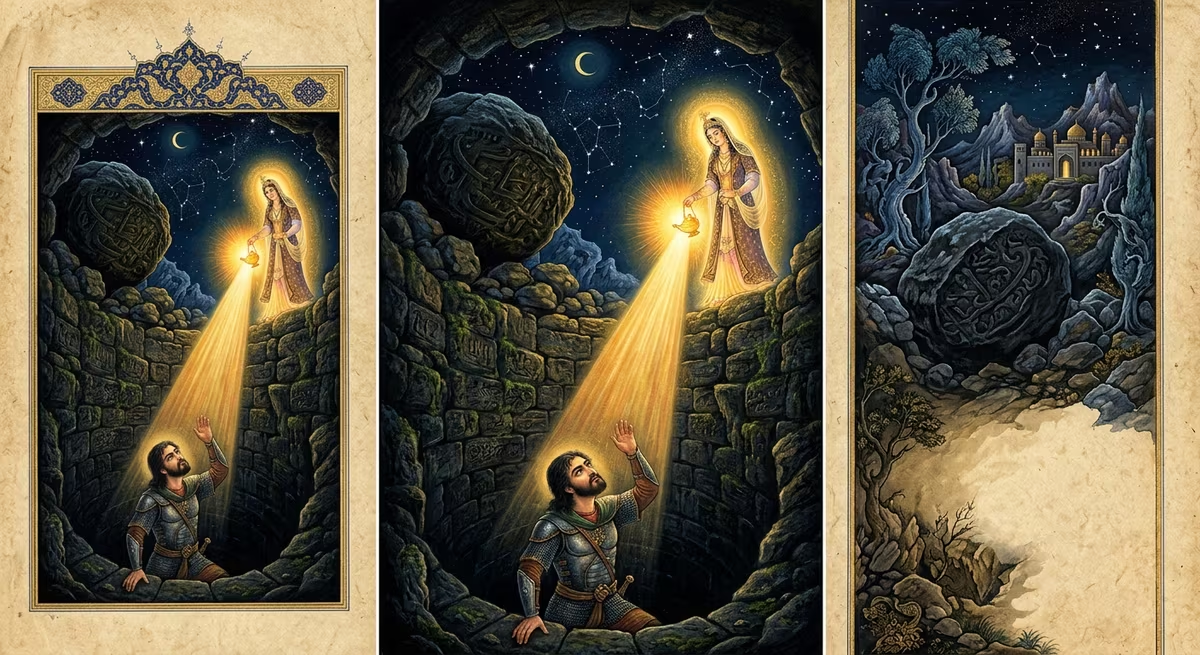
✨ Inscription Summary (Depth Psychological Key)
Afrasiab's dark well represents the dark abyss of the unconscious and repressed trauma where Bijan falls due to youthful inflation. His rescue by Rostam, guided by Manijeh, symbolizes psychological healing, Anima integration, and the courageous confrontation of inner shadows.
Bijan in Afrasiab's Well: Trauma, Repressed Memory, and the Inner Prison
The story of Bijan and Manijeh is one of the most compelling narratives in the Shahnameh: Bijan, a young Iranian knight, falls in love with Manijeh, the daughter of the Turanian king Afrasiab. Consequently, Afrasiab throws him into a deep, dark well, sealed with an enormous boulder (the Stone of Akwan), seemingly leaving no hope for rescue. This image serves as one of the most powerful mythological metaphors in the Shahnameh for a core Jungian concept: Repressed Trauma, where painful psychic material is pushed deep into the unconscious and "imprisoned."
The Well as a Metaphor for the Unconscious
In Carl Jung's symbolic language, images of wells, caves, or cellars represent the unconscious mind—a dark space hidden from the conscious Ego, which can be both highly dangerous and a treasure trove of truth and transformation.
Afrasiab's well is the perfect embodiment of this space: inside it, Bijan is completely severed from the external world (representing daily conscious awareness). He has no light, no communication, except for a tiny opening through which Manijeh feeds him. This image is a precise metaphor for how a traumatic experience or overwhelming emotion is deemed so threatening that the psyche buries and represses it. Yet, it does not disappear. Through tiny cracks—such as dreams, unconscious slips, or unexplainable anxieties—it continues to reach consciousness.
The Great Stone: The Mechanism of Repression
The giant boulder sealing the mouth of the well, which only Rustam—with strength far surpassing ordinary mortals—can move, symbolizes the power of psychological defense mechanisms. Repression is one of the strongest defenses: the psyche secures this barrier so tightly that the individual, relying solely on daily ego capacity, cannot access the buried trauma.
This is of great Jungian significance: Jung believed that repressed content, unless consciously confronted and integrated, manifests as psychosomatic symptoms, nightmares, or destructive behavioral patterns—much like Bijan suffering in silence and darkness, hidden from everyone except Manijeh.
Manijeh: The Bridge to Consciousness
Despite great personal risk (including punishment by her father for aiding an enemy), Manijeh visits the well daily to feed Bijan. This act represents the part of the psyche that, despite all defensive resistances, strives to maintain a link—however small—to the repressed content. Manijeh plays the role of an inner mediator: she cannot lift the heavy stone on her own, but she refuses to let the connection be severed.
Rustam: The Integrating Force of the Psyche
Bijan's ultimate liberation occurs only with the arrival of Rustam—the champion widely recognized by mythological analysts as the symbol of the Self (the integrated whole) or the transcendent force of the psyche. Only when this supreme integrating force is activated is the defensive boulder cast aside, allowing Bijan to emerge from darkness into light.
In a Jungian sense, this is a powerful metaphor for deep psychotherapy or self-discovery: repressed trauma is rarely accessible by mere everyday conscious willpower; it requires an integrating force—whether we call it the Higher Self, the assistance of a guide, or a profound transformative experience—to shatter the defensive barrier.
Bijan's Return: Integration After Confrontation
Following his rescue, Bijan does not merely return to life; he marries Manijeh and the narrative culminates in their union rather than forgetting the past. This is psychologically vital: the goal of confronting repressed trauma is not to delete or deny the painful experience, but to integrate it into a richer, more complete narrative of life. Bijan carries the memory of the well, but he is no longer its prisoner.
Why This Story Matters Today
The legend of Bijan reminds us of the Jungian truth that repression, though it may offer short-term psychological safety, comes at a heavy price: isolation, hidden suffering, and arrested psychological development. Yet, it is also a story of hope—it demonstrates that even the deepest wells of the psyche can be opened when met with the right integrating force.
Conclusion
Bijan in Afrasiab's Well stands as one of the most accurate mythological metaphors in Persian epic literature for the process of repression and psychological liberation. Alongside the figures of Manijeh and Rustam, this story provides a complete map of the path to confronting hidden trauma: preserving the connection, enduring with patience, and finally, evoking an integrating force that can lift the heavy stone of silence from the face of truth.
Frequently Asked Questions (FAQ)
❓ What does Afrasiab's well symbolize psychologically?
The dark well represents the deep unconscious, repressed trauma, and accumulated psychic pain where one falls after facing severe psychological wounds.
❓ What is Manijeh's role in saving Bijan?
Manijeh symbolizes the Anima (the feminine aspect of the male psyche) who, through loyalty and keeping a fire lit at the well's opening, maintains the bound Ego's connection to outer awareness.
❓ Why was the boulder sealing the well so heavy?
The heavy stone represents the defense mechanism of 'Repression' deployed by the psyche to prevent painful memories from flooding the ego, requiring the heroic strength of Rostam to roll back.
❓ What does Rostam's disguise as a merchant mean?
It shows that to heal trauma, the force of consciousness (Rostam) must not enter with aggressive force, but with wisdom, flexibility, and a smart disguise (the merchant persona) to penetrate the deep psyche.