Attar's Conference of the Birds: Thirty Birds in Search of the Self
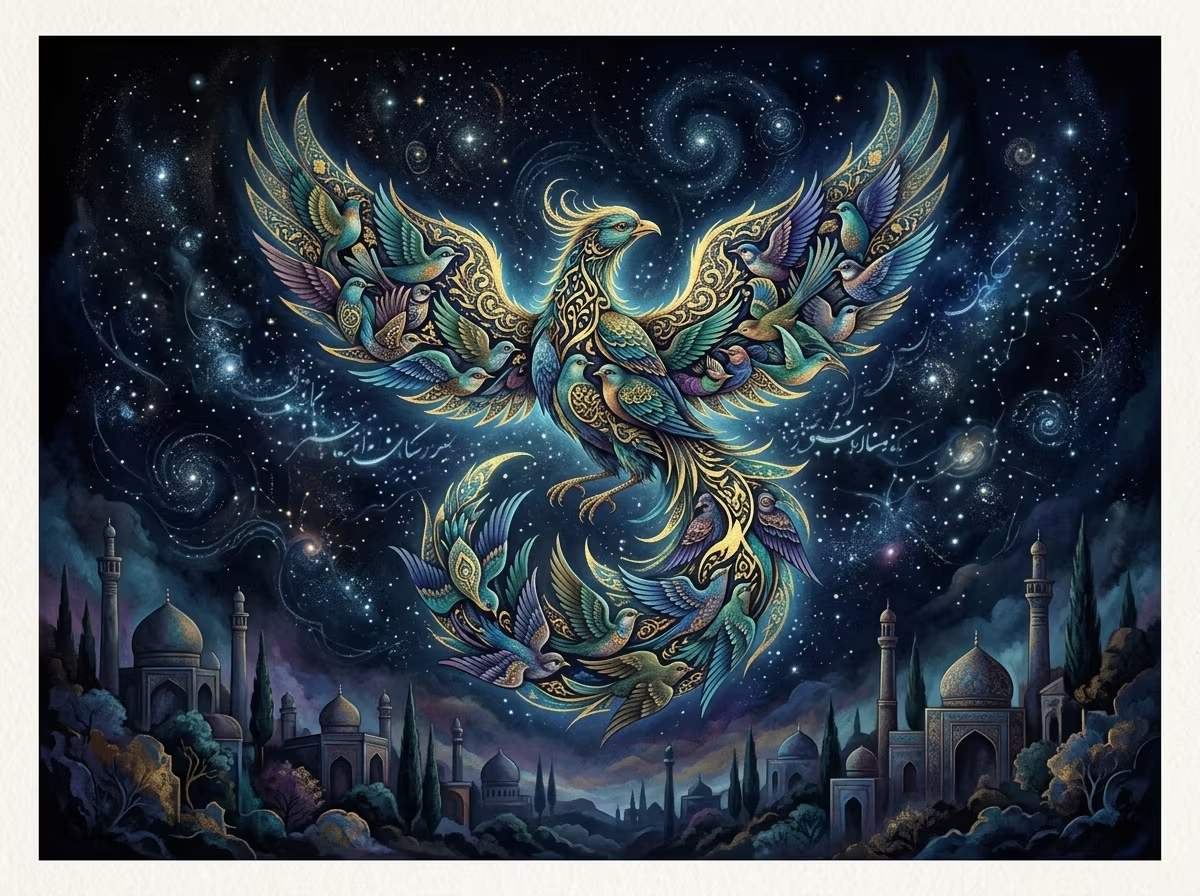
✨ Inscription Summary (Depth Psychological Key)
Attar's Conference of the Birds is a sublime allegory of the Jungian individuation process. Thirty birds cross seven perilous valleys only to realize that the mythical Simurgh is their own true, integrated Self. This inner quest symbolizes the unification of opposites and reaching psychological wholeness.
Attar's Conference of the Birds: Thirty Birds in Search of the Self
If we were to find the most precise metaphor in Persian literature for the Jungian concept of "Individuation," perhaps no work is as complete as Farid ud-Din Attar’s The Conference of the Birds (Mantiq al-Tayr). Seven centuries before Carl Gustav Jung coined the term "individuation process," this masterpiece narrated the exact same journey—with all its stages, hardships, and startling conclusion.
The Story at a Glance
Thousands of birds, led by the Hoopoe, embark on a perilous journey to find their mythical king—the Simurgh. Along the way, many birds abandon the journey out of fear, fatigue, or attachment to worldly pleasures. In the end, only thirty birds (Si Morgh in Persian) reach the destination—and there, they discover that the "Simurgh" they sought is nothing but a reflection of themselves: "Si Morgh" (thirty birds).
Jungian Individuation: A Journey Toward the Self, Not Beyond It
Jung viewed individuation as a process where an individual, instead of seeking perfection outside themselves, gradually achieves integration and a deeper understanding of their true Self. The key point is that the goal of this journey is not to find something external, but to discover and accept what has always existed within.
The ending of The Conference of the Birds narrates this truth with an ingenious linguistic play: "Si-Morgh" (thirty birds) and "Simurgh" (the mythical bird) are pronounced identically in Persian. The birds that traveled to find a divine, external entity realize at the end that what they sought was themselves—in their most complete and integrated form.
The Seven Valleys: The Map of Individuation
Attar divides the birds' journey into Seven Valleys, each of which can be seen as an equivalent to the stages of the Jungian individuation process:
- The Valley of Quest (Talab) — The beginning of search, the moment one emerges from the inertia of mundane ego-consciousness.
- The Valley of Love (Eshq) — Deep, passionate engagement with the process, beyond superficial curiosity.
- The Valley of Knowledge (Ma'refat) — Gaining initial insight and self-understanding.
- The Valley of Detachment (Istighna) — Letting go of external dependencies and expectations—the psychological equivalent of liberating oneself from the Persona and societal expectations.
- The Valley of Unity (Tawhid) — Experiencing integration, approaching the synthesis of inner opposites.
- The Valley of Bewilderment (Hayrat) — Facing ambiguity and the complexity of existence, a stage where conscious awareness alone is no longer enough—akin to confronting the unconscious in its darkest moments.
- The Valley of Poverty and Annihilation (Faqr & Fana) — The dissolution of the small "ego" into the larger "Self"—the exact moment Jung describes as achieving the Self.
Why Did So Many Birds Abandon the Journey?
With remarkable psychological precision, Attar details the reasons why various birds drop out: one due to love for a worldly beloved, another due to fear, one due to attachment to wealth. Each of these, from a Jungian perspective, represents the attachments of the Ego that prevent the individual from continuing the arduous path of individuation. Individuation, as Attar shows, is not a path everyone can or wants to walk to the end—because it requires letting go of familiar comforts.
The Hoopoe: The Guide of the Wise Old Man
The Hoopoe, leader of the birds, plays the archetype of the Wise Old Man—a guide who is not the Simurgh himself, but knows the way and encourages the birds in moments of doubt and despair. This is exactly the role Jung attributed to this archetype: not solving the problem directly, but a guide who enables the discovery of the path by the individual themselves.
Why This Metaphor Matters Today
The Conference of the Birds reminds us that much of what we seek outside ourselves—in the form of perfection, ideal love, or absolute success—is ultimately attainable only through a deeper discovery and acceptance of ourselves. The outward search, if walked with courage and honesty, often returns us to the very point that was within us from the beginning—but this time, with greater awareness and integration.
Summary
Through a simple and beautiful allegory of birds, Attar narrates the deepest truth of Jungian analytical psychology: the journey toward perfection is ultimately a journey toward the Self. "Si-Morgh" (thirty birds) and "Simurgh" are one—just as the individuated and true Self of every human being merges with itself at the end of a long journey of self-discovery.
Frequently Asked Questions (FAQ)
❓ What is the psychological meaning of the linguistic pun between Si-morgh (thirty birds) and Simurgh?
It signifies that individuation is not about seeking external perfection, but about integrating and unifying all scattered parts of the psyche into the higher Self.
❓ Which psychological stages correspond to Attar's Seven Valleys?
It starts with the awakening of the ego (Quest), continues with shedding the Persona (Detachment), integrating psychic opposites (Unity), confronting unconscious ambiguity (Bewilderment), and ends with the ego's surrender to the Self (Annihilation).
❓ What is the role of the Hoopoe in the birds' journey?
The Hoopoe represents the Wise Old Man archetype, answering the birds' doubts with wise parables and encouraging them to discover the truth within themselves.