Ahriman: The Shadow That Transcended the Personal to a Cosmic Scale
✨ Inscription Summary (Depth Psychological Key)
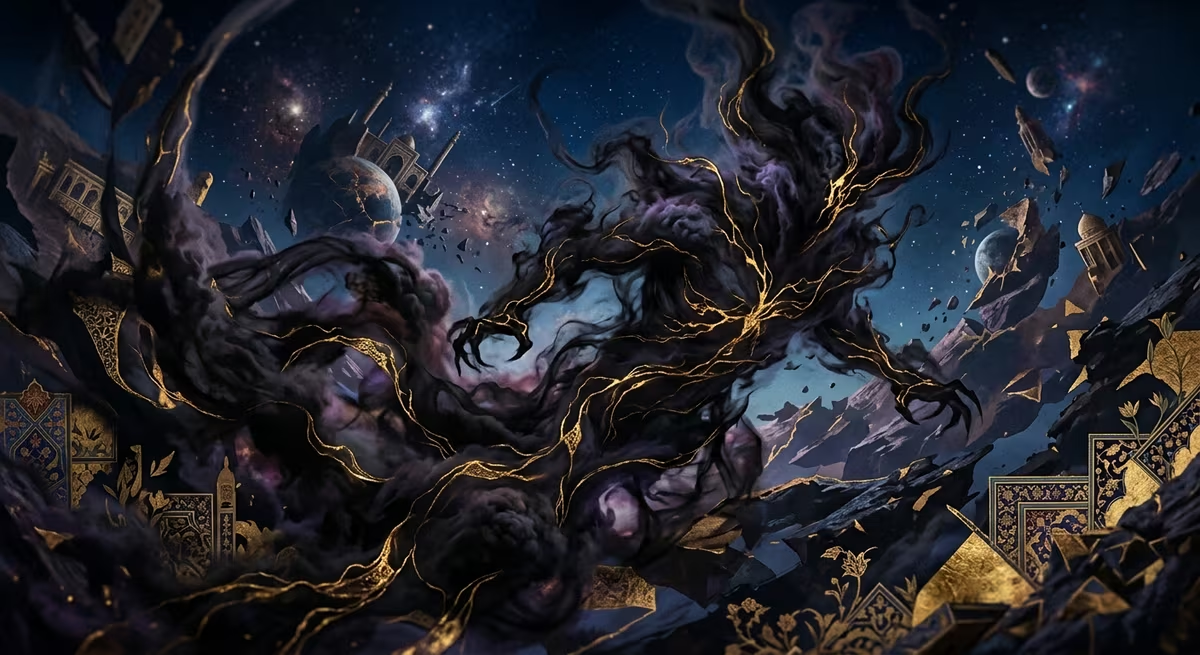
In Zoroastrian philosophy, Ahriman is the personification of the shadow at its highest, most abstract level—the cosmic shadow. Unlike personal shadows (Zahhak) or collective ones (Kaveh), Ahriman represents the absolute principle of decay, structural chaos, and deceit, locked in an ongoing cosmic tension opposite order (Ahura Mazda).
Ahriman: The Shadow That Transcended the Personal to a Cosmic Scale
If Zahhak represents the repressed personal shadow, and Kaveh symbolizes the moment this shadow is liberated at a collective level, Ahriman—the force of evil in Zoroastrian thought—takes the shadow to its highest and most abstract level: the cosmic shadow, a force tied not to a single individual or nation, but to the entirety of existence and cosmic order.
Three Levels of the Shadow: From the Personal to the Cosmic
To understand Ahriman's psychological significance, it is helpful to contrast the three levels we have explored in this collection:
-
Zahhak — Personal Shadow: The repressed parts of an individual which, if constantly fed, manifest as personal tyranny and malice.
-
Kaveh — Collective Shadow: The accumulated suffering of a society, released at a specific historical juncture and converted into action.
-
Ahriman — Cosmic Shadow: The force of darkness, decay, and chaos positioned at the level of all existence, standing opposite cosmic order and light (Ahura Mazda) in Zoroastrian cosmology.
This hierarchy demonstrates that Iranian myths possessed a highly sophisticated understanding of darkness and the shadow across varying scales—concepts that Carl Jung, thousands of years later, translated into the language of modern psychology, primarily focusing on the personal and, to some extent, the collective levels.
Ahriman as the Principle of Decay and Chaos
In Zoroastrian thought, Ahriman is not merely a "bad character," but the personified embodiment of decay, the lie (druj), and chaos, standing directly opposed to order, truth (asha), and creation. This distinction is crucial: Ahriman represents a conceptual, cosmological force, rather than merely a human adversary like Zahhak or Afrasiab.
From a Jungian perspective, this level of abstraction reflects a profound psychological need: to understand and confront darkness on a grand scale (universal suffering, systemic injustice, historical catastrophes), humans require symbols that transcend any single individual or specific society. Ahriman performs this role: serving as a symbol for a darkness that no single individual or group can be held solely responsible for, nor defeat alone.
The Cosmic Battle: Why Absolute Victory is Not instantaneous
An important aspect of Zoroastrian thought is that the struggle between Ahura Mazda and Ahriman is an ongoing, active warfare, rather than a single, historical victory (contrasting with Fereydun's definitive defeat of Zahhak). This symbolic difference is deeply meaningful: while at the personal and collective levels the shadow can be bound and managed (like shackling Zahhak inside Mount Damavand), at the cosmic level, darkness remains a permanent part of the continuous tension of existence.
From a Jungian standpoint, this can be seen as an allegory for a fundamental truth of analytical psychology: the shadow is never fully or finally "resolved." The process of confronting and integrating the shadow is a continuous, lifelong work, not a one-time achievement that can thereafter be ignored.
Human Choice: Active Agency Against the Cosmic Shadow
What rescues Zoroastrian thought from absolute fatalism is the belief that human beings, through "good thoughts, good words, good deeds," play an active and necessary role in this cosmic battle. Even in the face of a vast, abstract cosmic shadow, the individual is never passive; each person's daily moral choices are deemed an essential part of this grand, universal tension.
Why Ahriman Matters Today
The concept of Ahriman as a cosmic shadow helps us confront large-scale suffering and systemic decay (for which no single individual or group is fully responsible) without collapsing into absolute despair. This perspective reminds us that even when the shadow on this scale never fully disappears, individual moral choices retain their full meaning and ultimate significance.
Conclusion
Ahriman, as the manifestation of the shadow at its highest level of abstraction, is the essential complement to Zahhak (the personal shadow) and Kaveh (the collective shadow). This trilogy demonstrates that Iranian myths offer a comprehensive understanding of darkness across multiple dimensions—a perspective that continues to provide valuable guidance for modern humans confronting darkness, on whatever scale it may manifest.
Frequently Asked Questions (FAQ)
❓ What is the difference between the cosmic shadow (Ahriman) and the personal shadow (Zahhak)?
The personal shadow consists of repressed individual traumas and drives, manageable via self-awareness; the cosmic shadow (Ahriman) represents systemic decay, immense catastrophes, and universal human suffering that no single individual is responsible for.
❓ What is the role of human moral agency against the cosmic shadow?
By emphasizing good thoughts, words, and deeds, Zoroastrian philosophy rescues humans from existential despair, viewing every small moral choice as a direct reinforcement of light and order over decay.